Featured Review
“Great skilled guy with lots of experience, completed the project exactly as I expected. I will come back with more projects”

Boi Boi
Entrepreneur | Vietnam
I help startups and agencies build, improve, and ship reliable Android and full-stack products, from mobile apps and web platforms to APIs, dashboards, and backend systems.

Monjel Sabbir
Android & Full-Stack Software Engineer
Focus
Clean products
Delivery mindset
Reliable & polished
Projects Completed
Happy Clients
Years Experience
Technologies
Collaborating with innovative startups, agencies, and teams worldwide to deliver high-quality digital products.
“Great skilled guy with lots of experience, completed the project exactly as I expected. I will come back with more projects”
Entrepreneur | Vietnam
“Sabbir did an amazing job turning my website into a mobile app. I'm really pleased with his quick and great service. His kind demeanor made the process go well. I strongly suggest him for his effective work, and I look forward to collaborating with him on more projects.”
Companies & Partners

Telecommunication Company

Internet Service Provider Company
-20230906-210344.svg)
Storelocal® Storage Locally Operated in USA
A focused selection of mobile and web products built for real business needs.
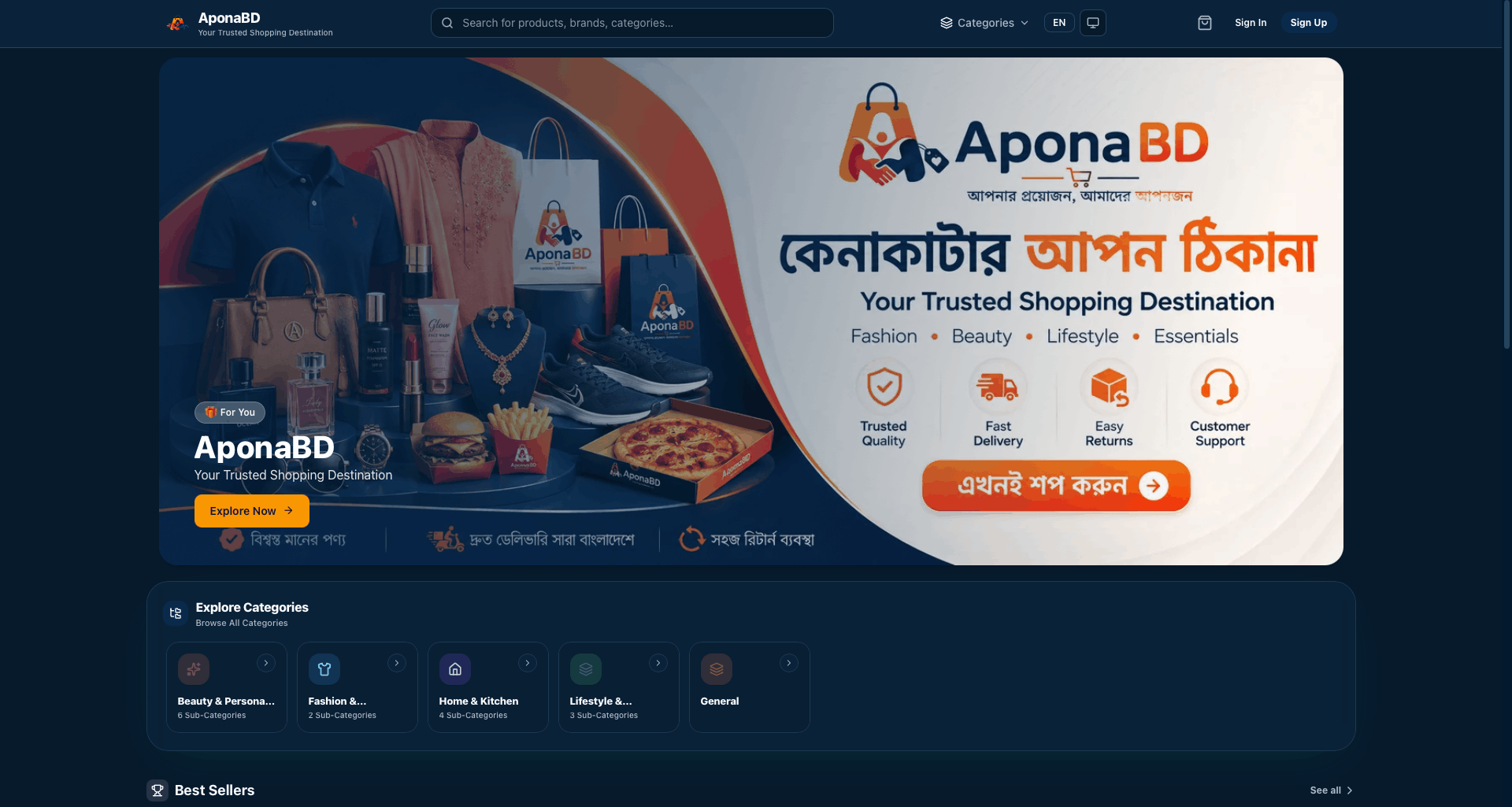
AponaBD is a production-ready, bilingual e-commerce platform designed for the Bangladeshi market. It provides customers with a fast, secure, and convenient shopping experience across desktop and mobile devices.I designed and developed the complete platform, including the customer-facing storefront, authentication system, checkout experience, order processing workflow, and a secure role-based administration dashboard.Key FeaturesBengali and English language supportProduct categories, variants, inventory, and SKU managementShopping cart and streamlined checkoutCash on Delivery and local manual payment supportCoupons, flash sales, referral rewards, and customer walletOrder tracking and automated order-status processingCustomer address book and support-ticket systemFraud-aware Cash on Delivery controlsGoogle authentication and two-factor authenticationRole-based dashboards for administrators and support agentsCloud-based product image storageConfigurable business, security, and feature settingsAreaTechnologiesFrontendNext.js, React, TypeScript, Tailwind CSSBackendNext.js Server Actions and APIs, Prisma ORMDatabasePostgreSQL, SupabaseStorageCloudflare R2InfrastructureVercel, Redis, CloudflareSecurityRole-based access control, 2FA, rate limitingMy Role: Founder, Product Designer, and Full-Stack DeveloperProject Type: E-Commerce PlatformWebsite: https://aponabd.com
Project OverviewThe Sunnah Store is a full-featured e-commerce platform built with Next.js and MongoDB. The project was developed collaboratively, with significant work focused on solving complex product-management, browsing, filtering, and user-experience challenges.I worked as a major contributor alongside the original author, implementing new functionality, improving existing features, and solving several technical and usability issues across the platform.My Role and ContributionMy involvement went beyond isolated UI changes. I contributed to both frontend functionality and data-driven application logic, with particular attention to performance, responsive behavior, and smooth product discovery.Key areas I contributed to included:Product management and listing functionalityCategory-based product discovery and filteringResponsive interfaces for desktop and mobile devicesCheckout and shopping workflowsPerformance-focused filtering and user interactionsDebugging and improving existing application logicImplementing additional features as the platform evolvedPerformance-Focused Product FilteringOne notable feature I implemented was a dual-handle price range slider that allows customers to adjust minimum and maximum product prices from either side and immediately see the selected range.The main challenge was ensuring that a highly interactive control did not generate unnecessary database requests whenever the user moved a slider handle.I implemented debounced filtering logic, allowing the interface to remain responsive while controlling when the application executes the underlying product query. This reduced unnecessary repeated requests while preserving a smooth filtering experience for the customer.Product Discovery and User ExperienceThe platform includes structured product browsing and category-based filtering, helping customers narrow down the catalog and reach relevant products more efficiently.Throughout my contributions, I focused on keeping interactions practical across different screen sizes and ensuring that data-driven features remained responsive without introducing avoidable processing or query overhead.Technical ImplementationThe application uses Next.js for the web application and MongoDB for persistent product and commerce data.My work involved integrating frontend interactions with the application's existing data layer, implementing query-sensitive functionality, and improving components without disrupting established business workflows.Key Technical FocusNext.js application developmentMongoDB data integrationDebounced product filteringDynamic price-range selectionResponsive UI implementationProduct and category management workflowsPerformance-conscious database interactionsCross-device compatibilityTeam CollaborationThis was a team-developed project, not an individual build. I worked within the existing architecture and contributed substantially after the original author, extending functionality and resolving complex implementation challenges while keeping new work aligned with the project's existing requirements.The portfolio URL represents a demonstration version of the project. Production deployments are maintained separately and have been used by third parties for business purposes.OutcomeThe project demonstrates my ability to work effectively on an existing production-oriented codebase, understand established application logic, and implement substantial improvements rather than relying on rebuilding features from scratch.It particularly reflects experience with e-commerce workflows, interactive product filtering, database-backed functionality, performance optimization, responsive development, and collaborative software engineering.
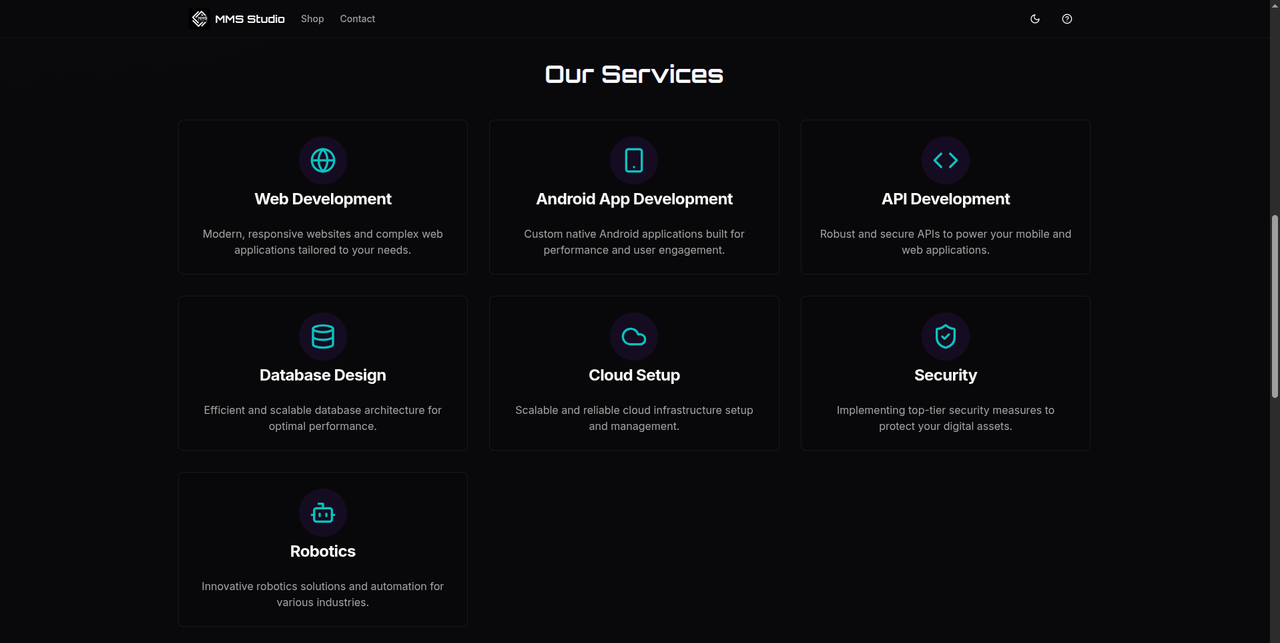
Project OverviewMMS Studio is my independently developed technology platform and the foundation for a broader software business I am building over time.Rather than functioning only as a portfolio website, it combines a company presence, developer portfolio, digital product shop, blog, payment verification workflow, and administrative system within a single platform.It has been actively maintained and evolved over time as my products and services have expanded.The ObjectiveI needed a centralized platform where I could present my development work while also handling payments and delivering different types of digital products and services.These offerings include:Software and application subscriptionsIn-app credits and coinsPremium access to apps and websitesAPI and service accessOther digital products and development-related servicesThe goal was to avoid treating the company website, portfolio, shop, and payment workflow as completely separate systems.My RoleMMS Studio is an independently developed and maintained project. I designed and implemented the platform across the frontend, application logic, Firebase integration, administrative tools, and deployment workflow.Because it is also used for my own products and services, development has been driven by practical requirements rather than being built solely as a portfolio demonstration.Digital Product & Service StoreThe shop provides a structured way to publish and sell digital offerings. Products can be organized into application categories and presented with their relevant pricing and information.Customers can purchase items such as subscriptions, credits, and premium access without requiring a traditional physical-product checkout process.Payment Verification & Access DeliveryOne of the platform's important functions is handling manual payment verification.For supported bKash payments, customers provide their transaction ID after completing payment. The system uses this information within the verification workflow and, after successful verification, can generate a redeemable coupon or access code for the purchased offering.This provides a practical bridge between manual payment methods and automated digital fulfillment.AdministrationI built a centralized administrative dashboard to manage the operational side of the platform.It supports functionality including:Secure administrator authenticationProduct and category managementPurchase monitoringPending, approved, and rejected transaction managementWebsite and content configurationManagement of relevant service settingsThis allows products, purchases, and platform content to be maintained without modifying the application directly for routine updates.Portfolio, Content & User ExperienceMMS Studio also acts as the public presence for my software work, providing visitors with information about available products, services, and development projects.A dedicated blog section supports longer-form content alongside the commercial parts of the platform.The interface was designed with a strong focus on a clean and modern experience across mobile, tablet, and desktop devices, keeping navigation between company information, products, content, and purchasing workflows consistent.Technical ImplementationThe platform is built primarily with Next.js, TypeScript, Tailwind CSS, ShadCN UI, and Firebase.Firestore provides the application database, while Firebase Authentication handles secured administrative access. The Next.js application uses the App Router architecture and is configured for deployment on Vercel.Core TechnologiesAreaTechnologyWeb ApplicationNext.js, TypeScriptUITailwind CSS, ShadCN UIDatabaseFirebase FirestoreAuthenticationFirebase AuthenticationOngoing ValueMMS Studio has grown beyond a static company or portfolio website into an operational platform supporting my software products and services.It gives me one place to showcase development work, publish content, offer digital products, process supported payment-verification workflows, and manage purchases and access delivery. Its architecture also gives me a foundation that can continue evolving as MMS Studio expands into a broader technology business.
Project OverviewThe ISP Billing & Network Management Suite is a proprietary organizational platform designed to centralize the operational workflows of an Internet Service Provider.The system brings together customer management, billing, network monitoring, payments, support, analytics, and customer self-service within a modular application ecosystem.It consists of three primary areas: an Admin Dashboard, Customer Self-Service Portal, and centralized Documentation module.Business ObjectiveISP operations involve several interconnected processes. Customer accounts must remain synchronized with billing, payments, network infrastructure, communications, and support activities.The platform was developed to provide a centralized system for managing these workflows while maintaining a scalable architecture that could support continued organizational development.My ContributionI contributed to the design and development of this proprietary organizational solution, working on functionality across the platform while following its existing backend and operational requirements.My work involved building and integrating frontend functionality, connecting application interfaces with the Laravel API, implementing data-driven workflows, and contributing to the modular structure of the overall system.Admin DashboardThe administrative application provides centralized visibility and control over day-to-day ISP operations.Core capabilities include:Customer lifecycle and account managementBilling-related workflows and automationMikroTik router monitoringSMS gateway integrationPayment managementRevenue and operational analyticsSupport and complaint managementAdministrative monitoring and controlsThe dashboard was designed to make complex operational information easier to access and manage from a unified interface.Customer Self-Service PortalA separate customer-facing portal allows ISP subscribers to securely access important account functionality without depending on administrators for routine tasks.Customers can:Access and manage their accountsReview billing and payment historyMake supported online payments through bKashView relevant account informationSubmit and track support complaintsThe portal provides a responsive interface with both light and dark modes, maintaining a consistent experience across different devices.Technical ArchitectureThe frontend applications were developed using React and Vite and integrated with a Laravel-based API backend.Axios handles API communication, while TanStack Query is used for efficient server-state management, including data fetching, synchronization, caching, and updates across data-driven interfaces.Monorepo StructureThe system uses a monorepo architecture to organize related applications and shared project resources.This approach keeps the Admin Dashboard, Client Portal, and supporting modules logically separated while allowing them to remain part of a coordinated development and deployment environment.ComponentPrimary PurposeAdmin DashboardISP operations, billing, customers, monitoring and analyticsClient PortalCustomer accounts, billing, payments and supportDocumentationCentralized system and operational documentationAPI BackendLaravel-based business logic and application APIsISP & Network IntegrationThe platform integrates ISP-specific functionality including MikroTik monitoring, connecting business-facing management interfaces with network-related operational data.This makes the project substantially different from a generic billing dashboard. The application has to present customer, financial, support, and network information within workflows suitable for real ISP operations.OutcomeThe project demonstrates experience working on a large, multi-application business system where frontend development must integrate with existing backend APIs, payment services, networking infrastructure, and operational workflows.It also reflects my ability to contribute to proprietary software involving billing systems, customer self-service, network management, API integration, server-state management, and modular application architecture.
Project OverviewCleanKart is a modern Android application designed to digitize the complete laundry service journey, from placing a pickup request to receiving cleaned clothes back at the customer's location.The platform was built to reduce the dependency on phone calls, handwritten records, repeated customer follow-ups, and other manual processes commonly used by local laundry businesses.It creates a structured connection between customers and partner laundry shops, making ordering, status tracking, communication, and service management easier for both sides.Problem & ObjectiveTraditional laundry services often operate through fragmented workflows.Customers may need to call a shop to place an order, explain their pickup address manually, contact the business again for status updates, and coordinate delivery separately.Laundry providers also face operational challenges when handling multiple customers, addresses, orders, promotions, and service updates without a centralized system.CleanKart was designed to bring these activities into one mobile platform.The objective was to create a convenient digital workflow covering:Customer registration and authenticationLaundry pickup requestsDelivery coordinationOrder status trackingCustomer location managementPartner shop collaborationPromotional couponsPush notificationsCustomer feedbackCustomer ExperienceUsers can securely create an account and manage their personal and location information directly from the application.Instead of contacting a laundry shop manually, customers can submit their service request through a structured ordering workflow.After an order is placed, they can follow its progress as it moves through different stages of the laundry process.This reduces uncertainty and gives customers better visibility into the status of their clothes.Pickup & Delivery WorkflowPickup and delivery are central to the service model.CleanKart stores relevant customer and location information so that laundry orders can be associated with the correct pickup and delivery details.This creates a more organized workflow compared with repeatedly collecting addresses through calls or messaging applications.Real-Time Customer CommunicationThe application integrates Firebase Cloud Messaging (FCM) to support push notifications.Notifications can be used to keep customers informed about important service events such as order updates, processing progress, or delivery-related changes.This reduces the need for manual communication while helping users remain informed throughout the service lifecycle.Partner Shop & Role ManagementCleanKart supports different types of users through role-based access and functionality.This allows customers and participating laundry shops to interact with the same platform while receiving features appropriate to their responsibilities.The role-management structure provides a foundation for expanding the application beyond a single laundry provider into a broader service network.Coupons & Customer RetentionLaundry is naturally a repeat-use service, so the application also includes features that support customer retention.Users can access available coupons and promotional offers, creating opportunities for repeat orders and targeted promotions.A built-in feedback system also allows customers to share their service experience after completing an order.Technical ImplementationThe application was developed natively for Android using Java.Firebase Authentication manages secure user access, while Firebase Firestore stores application data such as users, orders, service information, and other operational records.The application follows an MVVM architecture, helping separate UI components, application state, and data-related logic for better maintainability.Core TechnologiesAreaTechnologyMobile PlatformAndroidProgramming LanguageJavaDatabaseFirebase FirestoreAuthenticationFirebase AuthenticationNotificationsFirebase Cloud MessagingAccess ControlRole-Based User ManagementArchitectureMVVMBusiness ValueCleanKart converts a traditionally manual laundry workflow into a structured digital process:Order Request → Pickup → Processing → Status Updates → Delivery → FeedbackFor customers, this provides greater convenience, transparency, and easier communication.For laundry businesses, it creates a more organized foundation for managing orders, customer information, service updates, partner operations, and repeat customer engagement.The project demonstrates practical experience building a service-oriented Android application with authentication, cloud data management, push notifications, role-based functionality, and maintainable application architecture.
Project OverviewBD Tourist is a prototype travel management application designed to help travel agencies organize tours, customer bookings, seat availability, payment verification, and internal operations from a centralized system.The project explores how a traditional travel agency workflow can be transformed into a more structured digital experience for both travelers and agency administrators.Problem & ObjectiveTravel agencies often manage trip announcements, passenger information, seat availability, payments, and booking confirmations through a combination of phone calls, messaging applications, spreadsheets, and manual records.As the number of trips and customers increases, this workflow becomes difficult to coordinate.Common problems include:Keeping track of available and booked seatsOrganizing multiple upcoming and active toursMaintaining accurate traveler informationConfirming customer bookingsVerifying paymentsUpdating travelers when trip information changesSeparating administrative permissions between team membersBD Tourist was designed as a prototype solution for bringing these operations into a single structured travel-management platform.Tour Lifecycle ManagementTrips are organized according to their current stage, making it easier for both travelers and administrators to understand what is happening.Tours can be classified as:Upcoming for trips that are open or preparing for bookingActive for tours currently in progressCompleted for previously finished tripsThis lifecycle-based structure helps prevent current and historical tour information from becoming mixed together.Comprehensive Trip PlanningAdministrators can create structured tour information containing the details travelers need before making a booking.A trip can include information such as:Tour details and itinerary-related informationBooking methodsPricingSeat availabilityImportant travel informationBooking conditions and other relevant detailsPresenting this information within a consistent structure makes it easier for customers to evaluate available trips without depending entirely on direct communication with agency staff.Traveler Booking ExperienceThe customer-facing side of BD Tourist is designed to simplify trip reservations.Users can browse available tours, review important trip information, reserve seats, and manage relevant booking details through the application.The system also provides travelers with an organized way to stay informed when trip or reservation information changes.This creates a smoother journey from tour discovery to confirmed reservation.Seat & Booking ManagementSeat availability is an important operational requirement for group tours.BD Tourist incorporates seat information into the booking workflow, allowing the agency to coordinate reservations against the capacity of a particular trip.This reduces the difficulty of manually comparing booking requests with available seats and provides a clearer view of reservation activity.Payment VerificationThe project includes a structured payment verification workflow for customer bookings.Rather than treating a payment and its associated reservation as disconnected records, the system allows administrators to review booking and payment information together before confirming the relevant reservation.This helps agencies maintain greater control over booking approval and reduces ambiguity around payment status.Administrative ControlThe administration side provides travel agencies with centralized control over important operational activities.Administrators can manage areas such as:Tour creation and updatesCustomer bookingsBooking verificationPayment verificationSeat availabilityAgency membersTrip-related operationsThe objective is to reduce the amount of information that needs to be maintained across separate tools.Role-Based Access ControlTravel agency systems can involve multiple internal users with different responsibilities.BD Tourist therefore includes role-based access control, allowing permissions to be assigned according to a user's responsibility within the organization.This creates clearer separation between standard users, agency members, and administrators while protecting administrative functionality from unauthorized access.Prototype ScopeBD Tourist was developed as a prototype, with the primary goal of designing and validating a structured approach to travel-agency operations.The project focuses on the core workflows required to connect:Tour Planning → Publishing → Seat Booking → Payment Verification → Trip Management → CompletionIt demonstrates how multiple manual travel-management processes can be consolidated into a more cohesive application experience.Business ValueFor travelers, BD Tourist provides a clearer way to discover trips, understand availability, make bookings, and follow reservation information.For travel agencies, it creates a foundation for managing tours, customers, seats, payments, and internal responsibilities through one coordinated system.The project demonstrates experience designing software around real operational workflows, booking systems, role-based administration, payment verification, lifecycle management, and multi-user business processes.
High-impact development services designed for international startups, agencies, and product teams.
Java and Kotlin applications, Firebase integration, API development, Play Store delivery, bug fixing, and existing-app modernization.
Next.js, React, Node.js, dashboards, authentication, databases, payments, and business-management systems.
Short development sprints for agencies and startups that need bugs fixed, features completed, or delayed projects delivered.
My professional journey and the teams and companies I have worked with.
October 2021 – Present
Founded MMS Studio to design, develop, and deliver mobile applications, web platforms, digital products, and custom software solutions for local and international users. I manage the complete product lifecycle, from planning and UI design to development, payment integration, automation, deployment, and ongoing maintenance. Through MMS Studio, I have launched multiple Android applications and built practical digital solutions using Android, Java, Firebase, Next.js, Node.js, PHP, and cloud technologies.
November 2025 – June 2026
Contributed to frontend development, maintenance, and quality assurance for client projects. Built responsive, reusable interfaces from design and business requirements, resolved UI issues, integrated frontend components with backend APIs, and collaborated with the development team to deliver reliable production-ready features.
March 2025 – July 2025
Led the development and maintenance of AirLink BD’s ISP management system across its mobile application, website, and backend services. Built and supported operational features while prioritizing secure server-side access, role-based workflows, and reliable data handling.
May 2024 – September 2024
Managed day-to-day business operations, coordinating sales, customer service, inventory, and administrative activities to support smooth and reliable operations.
October 2019 – June 2021
Led management for TSB E-sports, securing and managing sponsorships, organizing online tournaments, and coordinating collaborations with external organizations. Planned and delivered initiatives from initial coordination through execution, helping ensure smooth events and productive partner relationships.
Proven expertise across modern web, native mobile, backend systems, and development tooling.
Native mobile and modern frontend product development
APIs, databases, authentication, storage, and deployment
Supporting frontend frameworks, state management, and web technologies
Development, version control, collaboration, and design workflow
Detailed feedback and recommendations from team leads, clients, and technical managers.
He delivered what it was asked. Great guy. Easy to communicate creative and great understanding. I would highly recommend him. Excellent developer with good knowledge with his works. Thanks to him for his neat and fast work and delivery. Highly Recommend.

Gamer | USA
Monjel Sabbir completed my assignment expertly and provided great after-care assistance. I'm happy that we worked together, and I'll use his talent on more projects in the future. Highly advised.
I strongly endorse Monjel Sabbir. We collaborated seamlessly on several clients projects, and his exceptional skills and dedication consistently ensured satisfaction.
Exceptional Good

Nigeria
Professional certifications and achievements that validate my expertise.
National Skills Development Authority (NSDA)
As-Sunnah Skill Development Institute
Bangladesh Technical Education Board
Google Cloud | Qwiklabs
Bongo Academy
10 Minutes School
Have a project in mind? Let’s discuss how I can help bring your ideas to life.
Direct Contact & Availability
Based in Bangladesh, working remotely with clients worldwide.
UTC+6
Typically within 12 hours.
Bangladesh
© 2020–2026 Monjel Morshed Sabbir. All rights reserved.
Back to top